Why Fast Typing Matters More Than Ever: The Research-Backed Case for Mastering Keyboard Speed in the Digital Age


In 2026, the average office worker spends over 22 hours per week typing. That’s nearly half a standard workweek glued to a keyboard. Yet most people type at just 35–45 words per minute (WPM)—the speed of an average typist. Professional typists and heavy keyboard users routinely hit 65–80+ WPM, and the fastest reach 100+ WPM with near-perfect accuracy.
The gap isn’t trivial. Research shows that doubling your typing speed doesn’t just save minutes—it transforms productivity, career prospects, cognitive performance, and even daily well-being. This research-oriented deep dive explains exactly why fast typing remains one of the highest-ROI skills you can develop in the AI-powered workplace.
What Makes A Fast Typist
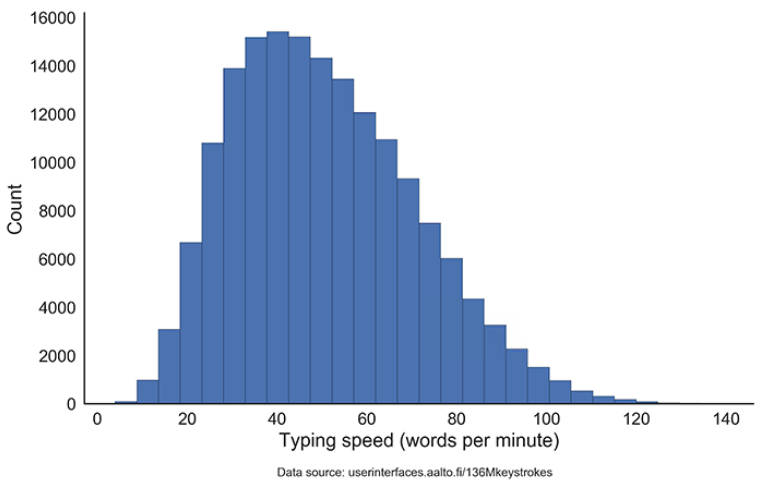
Figure 1: Distribution of typing speeds across 136 million keystrokes (Aalto University study). Most people cluster around 40 WPM; only a small percentage reach professional levels.
1. Productivity Explosion: Hours Saved, Output Multiplied
Fast typing directly attacks the biggest time thief in knowledge work: text input.
- An average two-finger typist (≈10 WPM) takes 17 minutes to type a 170-word paragraph.
- A touch typist at 60 WPM finishes the same paragraph in under 4 minutes.
Cumulatively, this adds up to hours per week. One analysis found that increasing typing speed by just 20–30 % can save 328 hours per year—the equivalent of 13 full days of work.
A 2025 survey of nearly 1,000 full-time employees confirmed that people already spend 22.3 hours per week typing. In high-volume industries (tech, finance, telecom), it’s 80 %+ of the workweek. Faster typists finish reports, emails, code, and customer tickets quicker, reclaiming time for high-value strategic work.
Real-world impact: Studies link higher typing speed to greater daily output and better work-life balance. Employees who type faster report completing more tasks and leaving work on time more often.
Excel Timesheet Formula: Track & Calculate Hours Easily
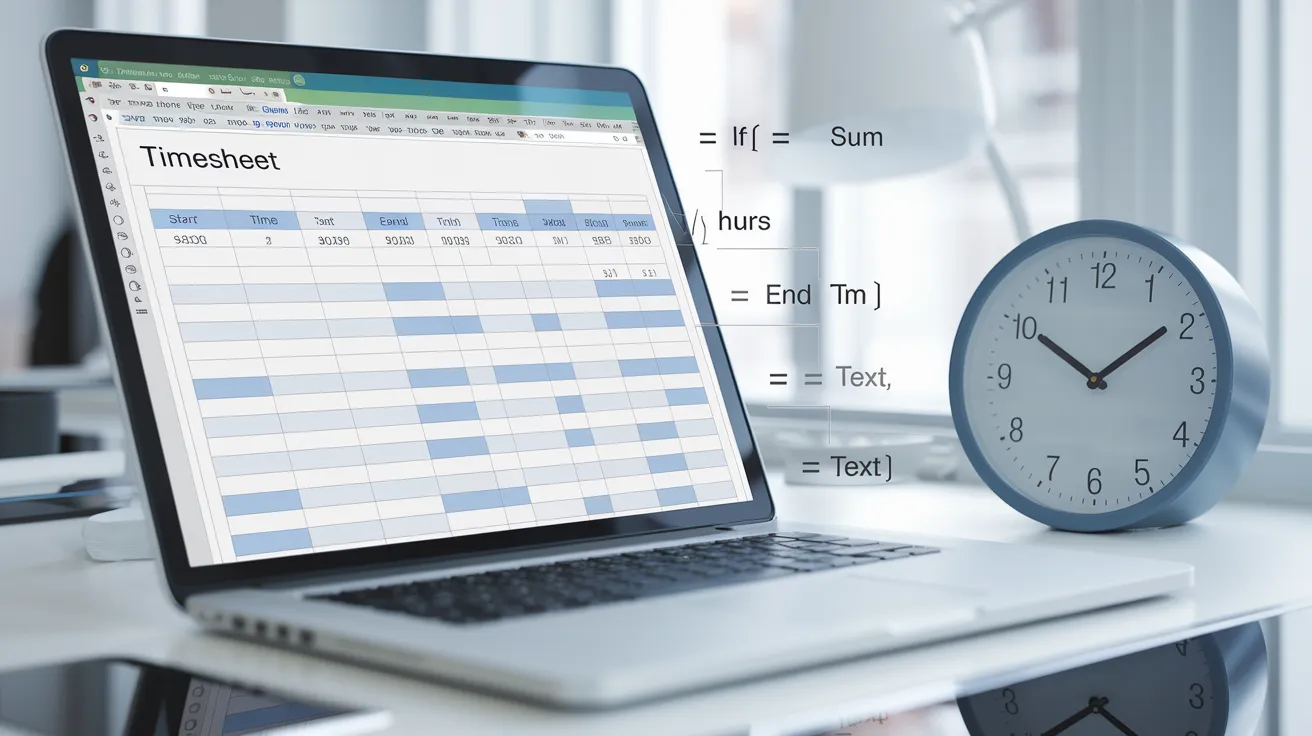
Figure 2: Visualizing time saved. Every extra WPM compounds across thousands of words typed daily, turning into weeks of reclaimed time annually.
2. Career Acceleration: A Hidden Hiring and Promotion Edge
Typing speed is still a predictor of job performance in roles involving documentation, communication, or data handling.
- Entry-level data entry/admin roles often require 60–80 WPM.
- Legal, medical transcription, journalism, and programming favor 70–100+ WPM.
- Employers explicitly test typing during hiring because speed + accuracy correlates with efficiency and professionalism.
A national U.S. study (High School and Beyond dataset) found that students who took keyboarding courses in school had significantly higher employment rates, earnings, and further education attainment—even after controlling for gender, race, and academic track.
Fast typists also appear more focused and competent in meetings, interviews, and live demonstrations. In competitive job markets, the candidate who can type 80 WPM while others struggle at 40 WPM stands out immediately.
3. Cognitive Benefits: Less Mental Friction, More Brainpower for What Matters
Touch typing shifts the skill from “controlled processing” (conscious effort) to automatic processing (muscle memory). This frees up the prefrontal cortex for higher-order thinking—creativity, problem-solving, and complex reasoning.
Recent 2026 research found that faster typing speed correlates strongly with:
- Better cognitive functioning across domains (especially perceptual speed).
- Fewer difficulties with daily living activities.
- Lower likelihood of certain self-reported health issues.
Fast typists also make fewer errors overall. A large keystroke analysis showed that higher speed and accuracy go hand-in-hand once you cross the ~50–60 WPM threshold.
Additionally, reduced cognitive load means less mental fatigue. Typists who reach flow state report entering a “zone” where ideas flow directly from brain to screen without the bottleneck of hunting for keys.
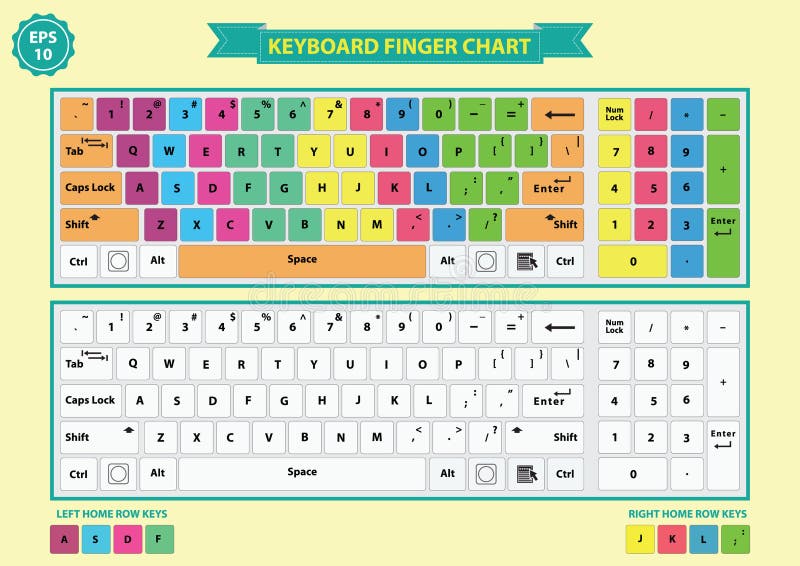
Chart Computer Finger Keyboard Stock Illustrations – 58 Chart Computer Finger Keyboard Stock Illustrations, Vectors & Clipart - Dreamstime
Figure 3: Proper touch-typing finger placement. Mastering this technique is what unlocks automaticity and the cognitive benefits above.
4. Health & Ergonomic Advantages
Slow “hunt-and-peck” typing forces poor posture—hunching, neck craning, and constant head movement. Touch typing keeps eyes on the screen and wrists neutral, reducing strain.
Studies on active workstations even show that while standing/stepping slightly slows typing speed, accuracy holds steady—and overall cognitive performance can improve when sedentary time decreases. Fast baseline typing makes these ergonomic setups more viable.
5. Benchmarks: Where Do You Stand?
CategoryAverage WPMWhat It MeansBeginner20–30Hunt-and-peckAverage adult35–45Most peopleOffice worker45–60Solid but improvableProfessional65–80+Competitive edgeExpert/Transcription80–100+Elite productivity
What is the average typing speed, average words per minute?
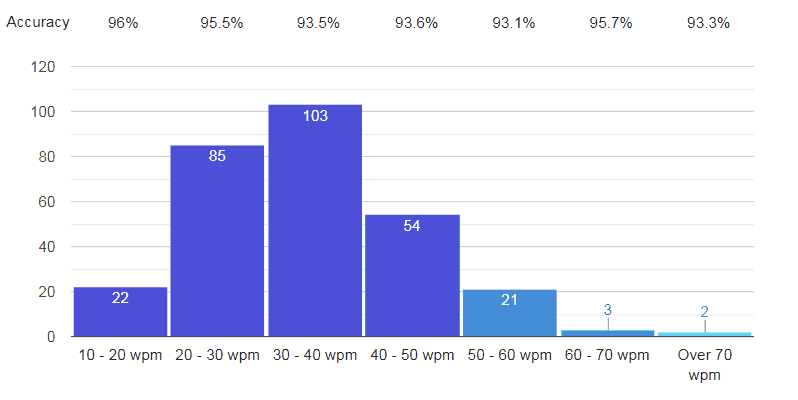
Figure 4: Accuracy remains high (93–96 %) even as speed increases. The myth that “fast = sloppy” is false once technique is solid.
The Bottom Line: Fast Typing Is a Superpower You Can Learn
In an era of AI tools, voice dictation, and automation, you might wonder if typing speed still matters. The data says yes—more than ever. AI still requires human input, editing, and oversight. The faster you can feed ideas into the machine (or collaborate in real time), the more value you create.
Fast typing isn’t about racing; it’s about removing friction so your brain can focus on what only humans do best: thinking, creating, and connecting.
Ready to level up?
Even modest practice (15–20 minutes daily) can push you from average to professional speeds within weeks. Your future self—and your employer—will thank you for the extra days, weeks, and cognitive bandwidth you’ll reclaim.
Start today. The keyboard is waiting.
Sources compiled from peer-reviewed studies, large-scale keystroke analyses, workplace surveys, and cognitive research published 2019–2026.


