Why Fast Typing Speed (60+ WPM) Gives You a Massive Edge in Jobs and Career Growth


Introduction to Fast Typing Advantages
Fast typing, typically defined as 60+ WPM with 95%+ accuracy, continues to be one of the most valuable and accessible digital skills in 2026. In an era dominated by digital communication, remote work, data processing, and content creation, the ability to convert thoughts into text quickly and accurately delivers measurable benefits. While the global average typing speed remains around 40–52 WPM, surpassing this benchmark significantly boosts productivity, employability, and overall work quality across virtually every computer-based role.
Time Savings and Productivity Boost
One of the most immediate and quantifiable advantages of fast typing is the substantial time savings it provides. A slow typist using two fingers at 10–20 WPM may take approximately 17 minutes to complete a 170-word paragraph, whereas a proficient touch typist at 60 WPM can finish the same task in roughly 4 minutes. Scaling this up to a full workday or week, where professionals often type thousands of words in emails, reports, notes, and documents, the difference can easily translate into 30–90 minutes saved daily. This freed-up time allows individuals to handle higher task volumes, meet deadlines with ease, or redirect effort toward more strategic and creative work. Higher typing speeds also reduce mental fatigue, as less cognitive energy is spent on locating keys and more is devoted to the quality of the content itself.
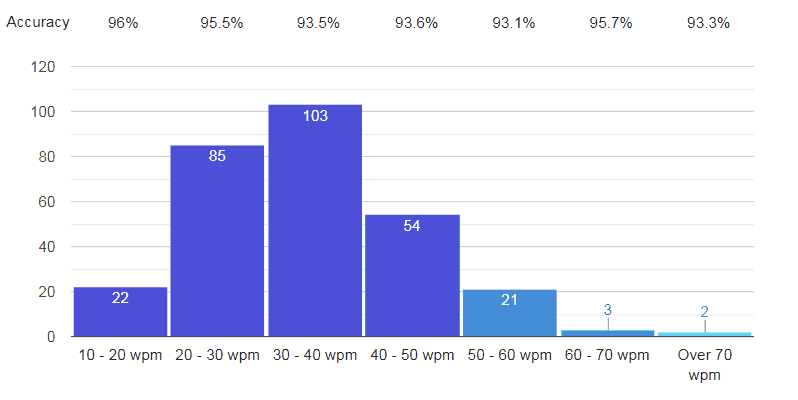
Here is a visual representation of how typing speed correlates with accuracy across different speed ranges:
Improved Accuracy and Reduced Errors
Fast typists who master proper touch typing techniques often achieve better accuracy alongside speed. Once the mechanical aspect of typing becomes automatic, error rates tend to decline because the brain focuses on ideas rather than key locations. Techniques such as key rollover further enhance flow and smoothness. In professional settings, higher accuracy means fewer revisions, cleaner documents, and reduced risk of costly mistakes — particularly important in data entry, legal work, or medical transcription where precision is critical. Studies and workplace data consistently show that balanced speed and accuracy lead to more reliable output and stronger professional reputation.
Career Opportunities and Employability Edge
Fast typing significantly enhances job prospects and employability in 2026. Many roles explicitly test or require minimum typing speeds during the hiring process. Reaching 60–80 WPM with high accuracy makes candidates stand out on resumes and helps them clear pre-employment assessments more confidently. In competitive remote and freelance markets — which are especially relevant for opportunities in Bangladesh and global platforms — faster typists can manage greater workloads and often command better rates. Even in roles not traditionally seen as typing-heavy, such as programming or management, quick typing accelerates documentation, note-taking, and communication, contributing to smoother workflows and positive performance evaluations.
The following chart shows typical minimum and preferred typing speed requirements across common job roles:
Failed to load image
Better Focus, Posture, and Reduced Fatigue
Beyond raw output, fast typing using correct touch-typing form promotes better ergonomics and physical comfort. Proper hand positioning reduces the tendency to hunch over the keyboard or strain the neck and wrists during long sessions. This leads to less physical fatigue and fewer repetitive strain issues over time. Mentally, the shift away from hunting for keys frees up cognitive resources, resulting in improved focus, clearer thinking, and higher-quality work. Many professionals report feeling more in control and less drained at the end of the day when typing becomes effortless.
The key benefits of strong typing skills are often summarized in this visual overview:

Where You Stand: Typing Speed Distribution and Benchmarks
Understanding where your speed fits in the broader population provides useful context. The average typing speed globally is approximately 40–52 WPM, with most people falling in the 35–45 WPM range for everyday use. Only a smaller percentage reach professional or advanced levels. For reference:
- Top 20%: Around 66+ WPM
- Top 10%: Around 76+ WPM
- Top 5%: Around 87+ WPM
Here is a percentile chart based on global typing test data to help you evaluate your current level:

hirebasis-strapi-production.s3.us-west-1.amazonaws.com
Achieving 60–80 WPM with strong accuracy positions you competitively for most office, administrative, remote, and freelance roles in the current job market.
Summary and Practical Advice
In conclusion, fast typing offers a powerful combination of time efficiency, higher accuracy, stronger career prospects, and improved daily comfort. It is a low-cost, high-return skill that compounds over time and remains highly relevant even as AI tools advance — because the ability to quickly and accurately turn ideas into polished text gives humans a lasting edge. To build this skill, dedicate 15–20 minutes daily to structured practice on platforms like Typing.com, Keybr, or 10FastFingers. Prioritize accuracy first, then gradually increase speed while maintaining at least 95% correctness.
If you share your current typing speed (test yourself on a reliable site), I can provide more personalized recommendations tailored to your goals, whether you are targeting data entry, transcription, virtual assistance, or general office work in Chittagong or beyond. Start practicing consistently — even modest improvements from average to solid professional levels can feel truly transformative in your daily work and career growth. 🚀